How Long Can a Baby Stay Under Water
5 Incredible Baby Skills
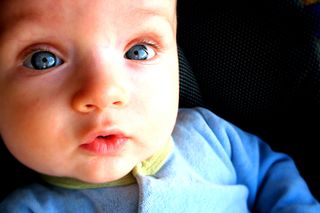
Babies may seem similar pathetic (merely cute!) human beings, and for the near office, they are. Just despite appearances (the fact that they don't know annihilation at all, can barely focus their optics and can't fifty-fifty support their own heads), they've got a few impressive tricks upwardly their sleeves.
The post-obit are five surprising things that newborn babies can exercise better than anyone else. Many are matters of life or death; others simply outcome from infants' fresh, unadulterated perspectives on the world they've recently arrived in.
Aquatic instinct
Newborn babies sport an assortment of automatic reflexes that they lose subsequently in development, as their brains gradually take the reins in matters of survival. Ane is the "diving reflex," also known equally the bradycardic response; as well exhibited by seals and other aquatic animals, the instinct may be a vestige of our ancient marine origins.
Information technology works similar this: Infants up to vi months sometime whose heads are submerged in water will naturally hold their breath. At the aforementioned time, their heart rates tiresome, helping them to conserve oxygen, and blood circulates primarily betwixt their most vital organs, the heart and brain. The survival response keeps accidentally submerged babies alive much longer than adults would survive underwater.
Rapid learning
Babies proceeds noesis at a staggering charge per unit. Near every experience they take is made permanent past the construction of a new synapse, or connectedness between encephalon cells called neurons. By the time a baby turns 3 years old, his or her encephalon has formed well-nigh 1,000 trillion connections, or twice as many as adults accept. Beginning effectually historic period 11, children's densely connected brains rid themselves of superfluous connections in a process calling "pruning."
Quantum intuition
Bear with u.s. for a quick physics lesson: Quantum mechanics, the bizarre set of rules that govern the behavior of elementary particles, is notoriously confounding. It says a particle (such every bit an electron or photon) is neither here nor there, but both places at once and everywhere in between, like a cloud rather than a ping-pong brawl. Only on the scale of large groups of particles does the fuzziness disappear, making homo-scale reality appear concrete and objects' locations seem well-defined. And there's the rub: Our experience of homo-scale reality prevents us from comprehending breakthrough mechanics, and even Albert Einstein couldn't intuitively grasp it.
Newborn babies, on the other mitt, aren't accustomed to reality at any calibration, and they are thus the merely people live who intuitively understand quantum mechanics, says Seth Lloyd, an skillful on quantum computing at the Massachusetts Establish of Technology. Up until the age of iii months or so, babies lack a sense of "object permanence," or the understanding that an object can be in but one place at one time. Before that time, experiments and games such every bit "Peekaboo" demonstrate that infants think a subconscious object could be absolutely anywhere — a startling demonstration of their intuition for quantum mechanics. [The Mysterious Physics of 7 Everyday Things]
Rhythm
Whether they'll grow up to be star ballroom dancers or to take two left feet, all babies are born with an innate sense of rhythm. This was demonstrated by a 2009 report in which a team of European researchers played a drum rhythm to sleeping ii- and 3-twenty-four hours-olds. The sequence occasionally skipped a beat, in some cases leaving the rhythm undisturbed and at other times making the rhythm stumble. When the latter happened, electrodes glued to the babies' scalps revealed that they exhibited a key encephalon response indicating their expectations had been contradicted (and thus that they acutely sensed the rhythm). [Why Do We Love Music?]
It could be that a female parent's heartbeat gets babies' rhythms on track while they're in the womb, or that their rhythm is instinctual. Regardless of the trigger, scientists think the sense may help babies learn and identify the cadence of their parent'southward speech, as well as that of their native language itself.
Being cute
No, really. The aforementioned traits aside, babies are so pathetic, needy and (at times) mind-numbingly wearisome that they would likely suffer neglect if they weren't then darn cute. Fortunately, well-nigh babies have got cuteness down pat. In research published last year, a team of Chinese and Canadian psychologists found that both men and women rate infants equally cuter than toddlers, who in plough were rated higher than immature children. Cuteness drops off considerably around the age of iv and a half.
That's when kids' facial structure really takes a plow for the less adorable, according to the researchers. Before that time, they accept exactly the features that we every bit a species accept evolved to find endearing, including a protruding brow, large head, circular face, large eyes and a small nose or rima oris. These cues override our natural disfavor to evil-smelling diapers. Cuteness really is a matter of life or death: Other studies have found that infants who have tiny eyes, flat foreheads and square faces are less likely to receive attending.
This story was provided by Life's Lilliputian Mysteries , a sister site to LiveScience. Follow Natalie Wolchover on Twitter @nattyover. Follow Life's Little Mysteries on Twitter @llmysteries, then join us on Facebook & Google+ .

Natalie Wolchover was a staff writer for Live Science from 2010 to 2012. She concord a available's caste in physics from Tufts University and has studied physics at the University of California, Berkeley. Follow Natalie on Google+.
Source: https://www.livescience.com/20802-newborn-baby-skills.html

Post a Comment for "How Long Can a Baby Stay Under Water"